· 6 min read
Half the Work in Twice the Time
I HATE wasting time. I’m the person who stops the microwave 3 seconds early because I can’t wait for the timer to run out. Small talk is a huge pet peeve…I’d rather have no conversation at all than one that skims the surface of dialog. I start a load of laundry, vacuum the house, sit down with a good book, and realize 4 hours later there are still wet clothes in the washer. (I think you get the idea...)
Some people might call me impatient, but to me it’s just passionate dislike for losing a single minute of my life to something I don’t want to be doing. That’s probably the main reason that I became a certified Scrum Master when I was working in engineering. The idea of doing “twice the work in half the time” lit a fire in me, and I wanted to spread it. But in reality, once I started working with teams full time, I realized I was up against a system that had us destined to fail from the start. One of the core values of Scrum is to minimize contextual switching (what most people call multitasking). The argument against it is that when we try to work on too many things at once, we do all of them slower and worse than if we’d done them one at a time. Every team I coached was split between multiple projects, initiatives, extracurriculars, and even roles. It was frustrating, but never surprising, when tasks got bumped out week after week during our planning meetings, because “…something came up.” Eventually, we got it done…but it was more like half the work in twice the time.
I remember people at work casually talking about how many projects they were actively working on like each one was a merit badge. There was an addiction to hyperactivity in the office. I'll admit that, especially early in my career, it felt really good to get shocked expressions from my cube neighbors when I told them I'd picked up yet another thing to add to my personal backlog. An overwhelming schedule stroked my ego, because it meant I could handle it (until I couldn't). It also meant I was proving myself to management. If I'd said no, then maybe I wouldn't be promoted next year. There’s a lot of pressure to keep ourselves insanely busy.
You know when you get home at the end of the day, and your spouse asks what you did today, and you have no idea? That was me most evenings after work (and most Mondays after the weekend). My attention had been so split between so many things that I honestly couldn't remember what I'd actually achieved or experienced. Like I said, I HATE wasting time. And if I didn't even remember how I was spending it, then how could I know if it had been a good investment?
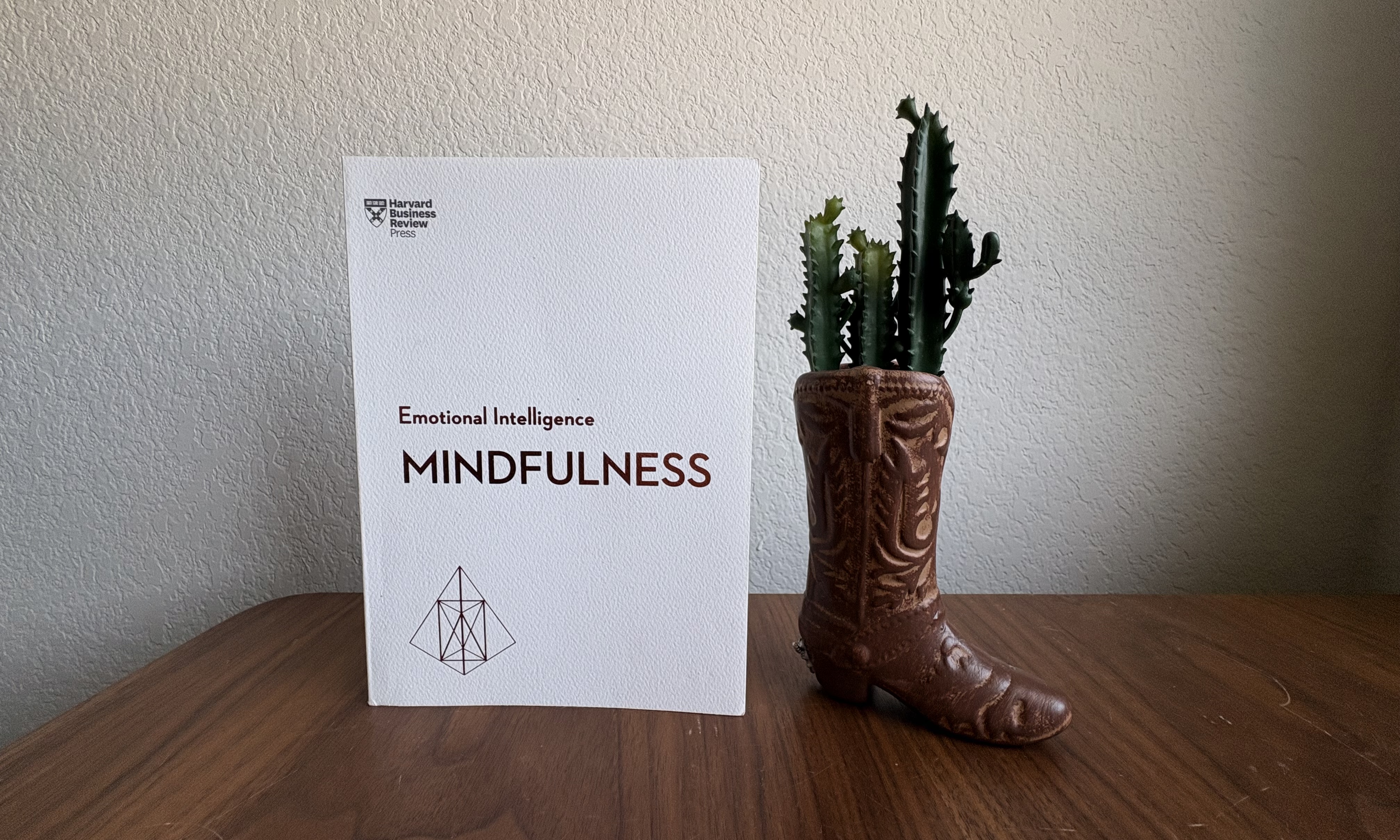
In 2018 I was walking through a bookstore in the Phoenix airport. I had just finished a work trip, and was feeling overwhelmed by a flood of meetings and updates from my normally remote team. A small white book with shiny gold font caught my eye—Mindfulness: HBR Emotional Intelligence Series—a collection of writings from the Harvard Business Review. It was the back cover that really sold me: “how to be human at work”…something that felt almost impossible at the time. Plus it was short enough that I figured I’d read it on the flight home, hoping to get some relief from the tension headache that was already well underway. Instead of opening the book, I spent the 6-hour journey home on my work laptop, taking notes from the week of endless meetings, prepping for the week ahead. That book sat on my shelf until May 2026 (yes, I finally just picked it up, 8 years later).
For most of my life I thought mindfulness was a slow-motion meditation practice that I knew would probably be good for me, but definitely never had time to actually do. But over those 8 years I’d given it more than a couple shots. My prior therapist introduced me to an exercise he called a body awareness scan. The idea was to mentally walk through each area of my body with the help of an 11-minute voice-guided recording, noticing the level of tension of every muscle. The first time I tried it I felt amazing! I followed the directions step by step, got in tune with myself, and my mind quieted like it was being politely shushed by a kind librarian. The next few times were different…I realized I’d memorized the recording, and started anticipating what was coming next. My mind wandered, and I wrote imaginary lists of all the things I could be doing besides this. It started to feel like I was wasting time. I thought I was failing the exercise, but I later realized that noticing the wandering is the practice.
Later I learned that mindfulness is not, by definition, lying on the floor listening to a recording of ocean waves (or a put-me-to-sleep voice-over body scan)…it could be dynamic. Yoga, in particular, taught me to be mindful in my movement, and that mindfulness could be a social activity. Baking, cooking, walking, even just breathing, all became platforms for aligning my attention to my actions. I definitely didn’t set any records for length-of-mindfulness doing any of these, but over time I noticed more and more when my mind drifted and when I was truly present. And the more I paid attention, the more aware I was of how I was using my time, and (at least I hope) the less I wasted it.
So now, 8 years after picking up that HBR book from an overpriced airport shop, I’m reading it from a fresh perspective. Looking back, I realize now why the version of me who didn’t make time for it then would lie awake in bed after a long day of work, worrying. The weight of uncertainty about how well I’d spent my day put a heaviness in my chest that I couldn’t name at the time. I was taking on too much at work, too many social commitments, and too many bad calories. I was chasing the dopamine hits of feeling “productive”...all while failing to realize what I’d actually done and whether it mattered to me.
In the book Rasmus Hougaard is quoted: “Mindfulness is not about living in slow motion. It’s about enhancing focus and awareness both in work and in life…[it’s] a great alternative to the illusory practice of multitasking.” For most of us, living mindfully doesn’t look like spending several hours a day in silent meditation (although that would be nice, I’m sure). We have to get things done. We have responsibilities to meet, people counting on us. But we don’t have to do it all at once…in fact, we shouldn’t, we can’t! The best thing we can do to make progress is to get clear on what’s most important, and give it our full attention.
🪷 Nora
Enjoyed this? Get the next issue in your inbox.
Join our newsletter for insights on career, lifestyle, and relationships.
Related Posts
May 14, 2026 · 8 min read
Dancing Up The Wall
Achieving control over experience to find joy in the doing, rather than the outcome.

Mar 26, 2026 · 5 min read
The Concert I Never Let Myself Want...
Fear didn't stop me from going. It stopped me from even wanting to...

Mar 19, 2026 · 3 min read
The jealousy I buried...
His big career move became my excuse to stop asking what I wanted.